
We have it at home. Probably.
Say what you bought and it sorts itself. One sentence, any order. No forms, no barcodes.
No need to type — tap one of these.
It runs straight away and sorts into the list below.
“Probably” is the expensive word.
You're in the aisle, trying to picture your own fridge. Do we still have eggs? Probably. So you guess.
Guess you haven't.
You buy another dozen. There was already a half-empty box in the door, so now there are eighteen eggs and one date to use them by.
Guess you have.
You walk past the coffee. You didn't have it, so it's Monday morning and there's none.
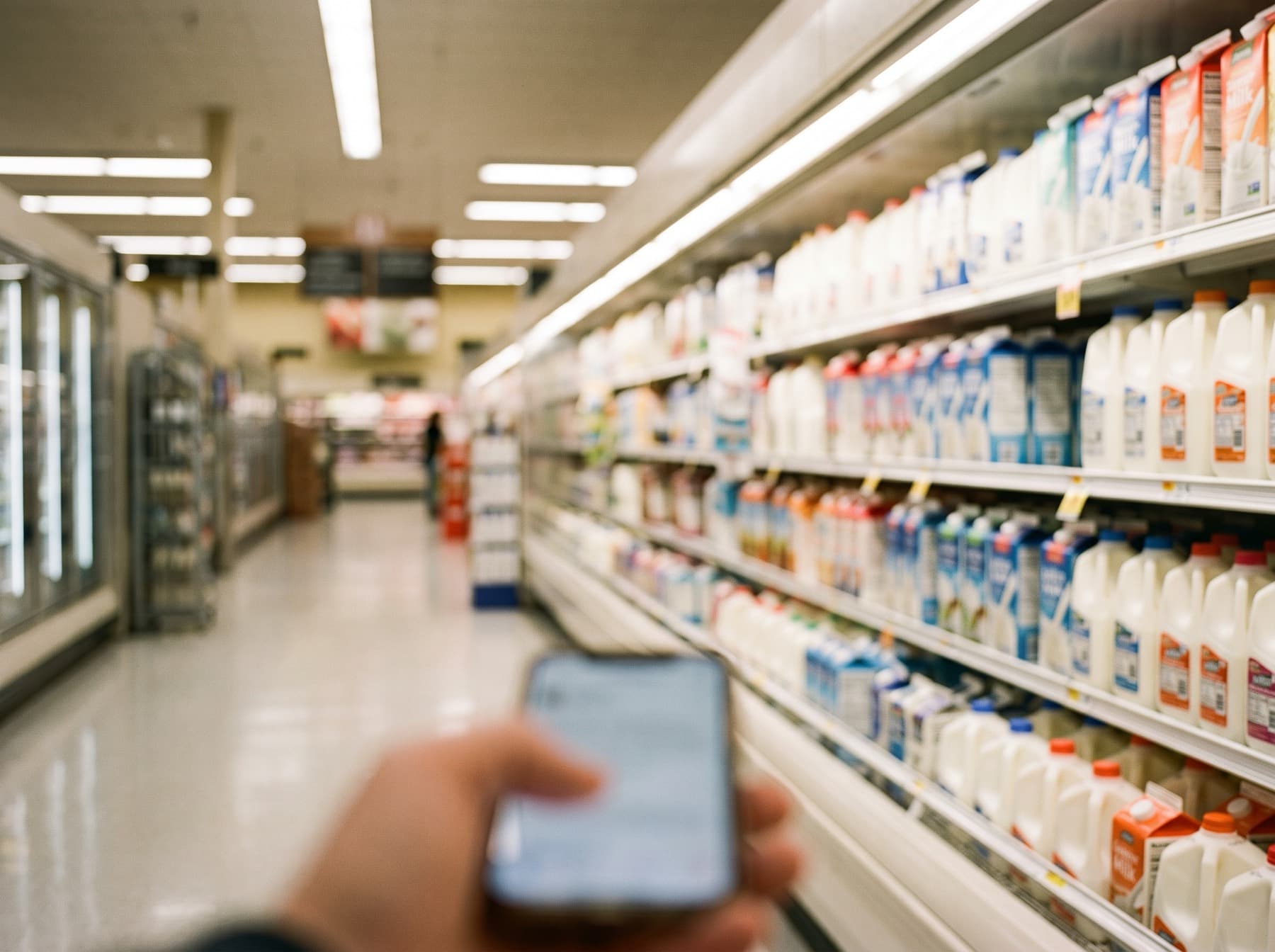
A household of four bins $56 of food a week, nearly $3,000 a year. Most of it was bought unplanned, or went off before anyone got to it.U.S. EPA, 2025ReFED
You stop guessing, because you said it once when you got home.
There is no weekly tidy-up and no form to fill in. You say what you bought, used or ran out of, in the words you'd use out loud, and that is the entire amount of work there is. Here is what it does with it.
Everything goes where it lives.
“A gallon of milk, a bag of rice and some dish soap.”
Three things, one sentence, said in whatever order they came out of the bag. The milk is filed under Fridge, the rice under Pantry, the dish soap under Household. You did not choose any of those, and there was no form.
It speaks up before you throw something away.
“Got a pack of chicken.”
Raw chicken is given about three days, because that is what raw chicken gets. You hear about it while there is still time to cook it, not when you open the drawer. If the packet says a date, say the date — yours wins, and it keeps winning.
The shopping list writes itself.
“We finished the coffee.”
Coffee is now on your shopping list. You did not open a list to put it there and you will not have to remember it — it is already waiting the next time you are in a shop, which is the exact moment you would otherwise have been guessing.
Three months free when it lands.
Supplied isn't live yet. What you just used is real. The rest of the app is in development, shipping late 2026. Leave an email and you're in; there's nothing to pay, now or at launch.
- Your first 3 months free, from launch day
- $4.99/month after that, only if you keep it
- A say in what gets built after version one
Not ready? Read the rest first.
No reviews. No users. Here's how we're building it instead.
This is the part of a landing page where the five-star quotes normally go. We don't have any, because nobody has used this yet, and inventing them is illegal, which is presumably why so many of them read the same.
So here is the rule instead. Version one ships simple, which means one way in and it is a sentence: no forms, no barcodes, no setup evening. Lovable, which means worth opening on a Tuesday, and if a screen is only tolerable it is not finished. And complete, which means whole on day one, with nothing shipping in a “coming soon” label. Then we add from the roadmap one thing at a time.
the Supplied team
What you'd ask before signing up.
The skeptical ones, answered plainly. Yours not here? Ask it.
That is the main way you will use it. Open the app, hold one button, say what you bought or used, and it is filed. No keyboard, no form, no picking a category — talking to it is the product, not a shortcut bolted onto it.
Typing stays for the times talking is not on — a quiet carriage, a sleeping house, a word it keeps mishearing — and you can always edit an item by hand if you would rather.
The mic on this page is an imitation of that, and it says so while it runs: it plays a recording, it is not listening to you. What is underneath it is real, though — and typing the sentence into the box does exactly the same job, through exactly the same parser, with exactly the same result.
No, and you shouldn't try. Mention the grocery run you just did, and that's ten items and about eight seconds. Next time you cook, mention what you used. Within a few days it knows the things you actually buy, which is a much shorter list than the things you own, and the only list that matters for not buying them twice.
Then that item is wrong until you mention it again, and everything else is still right. It isn't a system that breaks when you skip a day. It's a running note that's better than the one in your head, which is the only thing it's competing with.
Everything is editable after the fact: names, quantities, categories and dates. A correction sticks, so the next time you mention that item it already knows.
It estimates from typical shelf life for that kind of item, dated from when you said you got it, so it's an estimate, not a reading of the carton. When you know better, say so: “milk, use by the 12th” sets the real date as you add it, and you can edit any date afterwards. A date you gave it always wins over a date it guessed, and it stays put.
No. Fridge, freezer and pantry sit alongside everyday basics like toilet paper, dish soap and dishwasher pods. That's the whole point of the name.
Because you're already paying for not tracking it, just not to us. A U.S. household of four bins about $56 of food a week, and most of it goes off unopened or gets bought twice. $4.99 a month is about 2% of that.
In practice it pays for itself the first time it stops any one of these:
• A bag of spinach bought Sunday, found Thursday, binned Friday. that one bag is the month.
• A second bottle of dish soap because you couldn't picture the cupboard. Two months.
• A pack of chicken that went over while you were eating out. two months.
Most of us manage all three in the same fortnight. Stop one a month and it's free; stop two and you're up.
Nothing, and there's no card step. You leave an email, and the next time you hear from us is the day it launches. Your first 3 months are free from that day; after those, $4.99/month only if you decide to keep it. Signing up now doesn't start anything, doesn't renew anything, and isn't a queue you can lose your place in.
It ships late 2026, on the App Store and Google Play, iPhone and Android on the same day. There's nothing to download today. The demo on this page runs in the browser. We'll email you a link when it's live, and that's the only email you'll get between now and then.
Ask us anything.
A person reads every one of these, not a form queue. If something on this page doesn't add up, we'd rather hear it now than after launch.
What happens to your address
- We reply to every one, usually within a couple of days.
- Your address is only ever used to answer you.
- No list, no newsletter, no follow-up you didn't ask for.
Still here? It ships late 2026, and your first three months are free.
Get 3 months freeNo card now, and none when the 3 months end. One email to confirm you're in, one the day it launches.